Zentor (formerly Moclaw) · Client sample, shown with permission
What AI agent skills are: reusable working methods that let an agent meet the same standard when the task returns with different inputs.
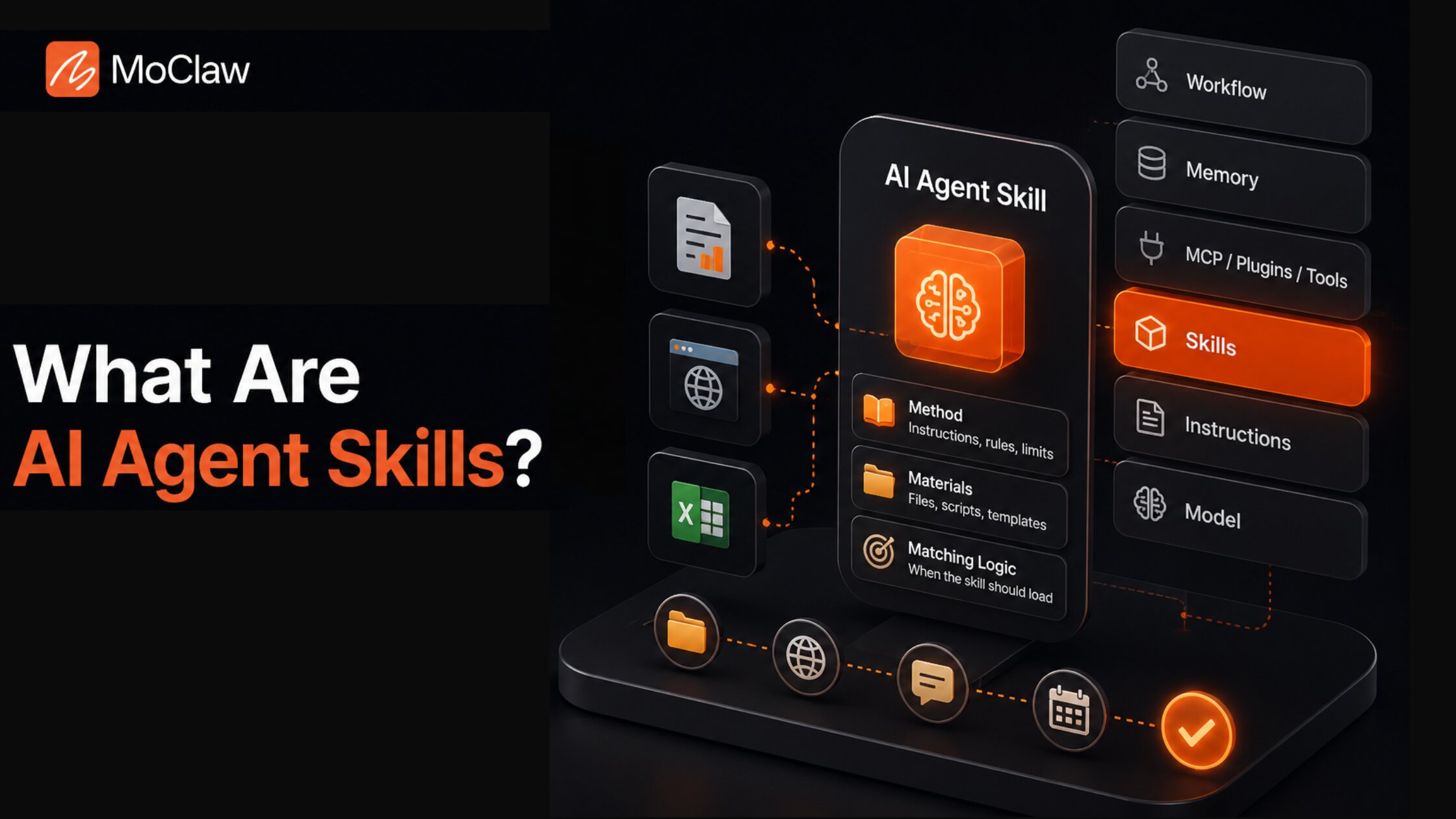
Alt: feature image
A good AI response can hide a weak working process.
It may answer the question, follow the brief, and look useful in the moment. The problem appears later, when the same type of work returns with different inputs, and the agent has to meet the same standard again.
Trust starts when the task returns and the standard holds.
If the agent needs the whole path rebuilt every time, the team is still carrying too much of the work.
AI agent skills bring a sharper question into focus: what can the agent carry into the next task?
What Are AI Agent Skills?
AI agent skills are reusable working methods that help an agent handle familiar tasks with clearer rules, context, and output standards.
By using the word skill in an agentic context, people usually mean one of two things.
The first one is the practical meaning. Skills in AI agents describe the abilities an agent brings into a workflow: planning, research, tool use, coding, file handling, communication, and escalation.
The other meaning is more structured. In agent systems, a skill can be a packaged unit of task knowledge. It may include instructions, rules, examples, scripts, templates, files, and metadata that guide how the agent handles a recurring job.
What connects both meanings is method.
An agent may have the ability to analyze a spreadsheet. A spreadsheet analysis skill can define what to check, what to ignore, how to format the result, and when the work needs review.
Agentic skills usually describe broader agent behavior, such as planning across steps, adapting to context, and using tools. AI agent skills are the more concrete layer: the part that turns those behaviors into something a team can reuse and improve.
The skill gives the agent a working route before the task begins. It reduces the chance that one run follows the standard and the next run quietly skips it.
How Skills Differ From Prompts
Prompts carry live intent. They tell the agent what this task needs right now: the goal, audience, constraints, files, or extra context.
Skills carry the part that shouldn’t have to be re-explained: the method, rules, examples, source logic, output standard, and review points.
When every recurring task needs a full-process prompt, the agent hasn’t really learned the work. It’s borrowing the user’s instructions for one run.
When Should You Use an AI Agent Skill?
Repetition alone is not enough. A task can repeat and still be too simple for a skill. The stronger signal is the process weight.
Use an AI agent skill when the task meets three conditions: it repeats, it has rules, and mistakes may create rework.
You need a skill when the agent must:
Follow a known sequence
Use approved sources or files
Apply the same judgment criteria
Produce the same output shape
Track what changed between runs
Pause before sending, publishing, editing, or deleting anything
Don’t use a skill when:
The task is rare and unclear
The goal changes every time
The user only needs a one-off answer
The agent would need broad permissions before the method is proven
That's why skills work well for research reports, competitor updates, lead lists, support drafts, content briefs, spreadsheet cleanup, and recurring internal summaries.
A simple rule helps: if you would train a teammate on the process, the agent may need a skill for it.
What’s Inside an AI Agent Skill?
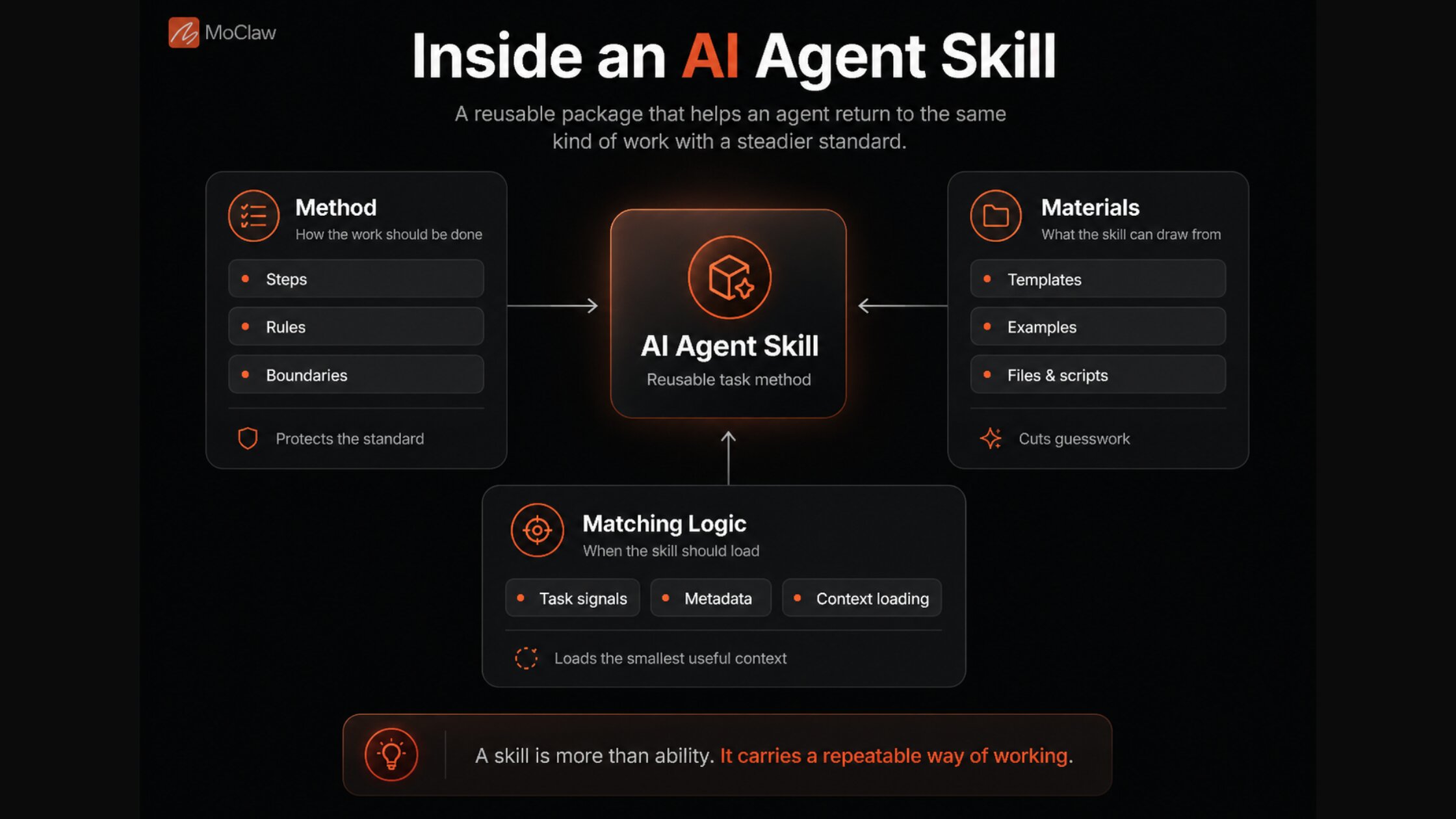
Alt: components of skills in ai agents
A strong skill usually has three layers: method, materials, and matching logic.
The Method: Instructions, Rules, and Boundaries
Instructions define the steps, quality bar, output format, and common mistakes to avoid.
Rules set the limits. They tell the agent when to pause, when to ask for approval, what to leave untouched, and which sources deserve more weight.
For a support skill, the method may require the agent to check policy before drafting a reply, avoid refund promises without approval, and flag angry customers before any response goes out.
This layer turns a loose ability into a standard.
The Materials: Code, Files, Templates, and Examples
Some skills carry reusable assets.
That can include a cleanup script, report template, source list, sample output, brand guide, file format, or layout rule.
These assets reduce guesswork. The agent doesn’t have to infer the standard from a vague request or rebuild the same structure from memory.
It works from an asset, not a guess.
The Matching Logic: Triggers, Metadata, and Context Loading
A skill needs a way to recognize the right task.
A spreadsheet upload, lead research request, report brief, file conversion task, or support ticket can all point the agent toward a specific method.
Good skill systems avoid flooding the agent with every instruction at once. The system can show a basic description first, then load deeper instructions, files, or code only when the task requires them.
Too little context leaves the agent guessing. Too much makes it carry noise.
Good skills load the smallest useful set of instructions for the job.
Why Skills Matter in AI Agents
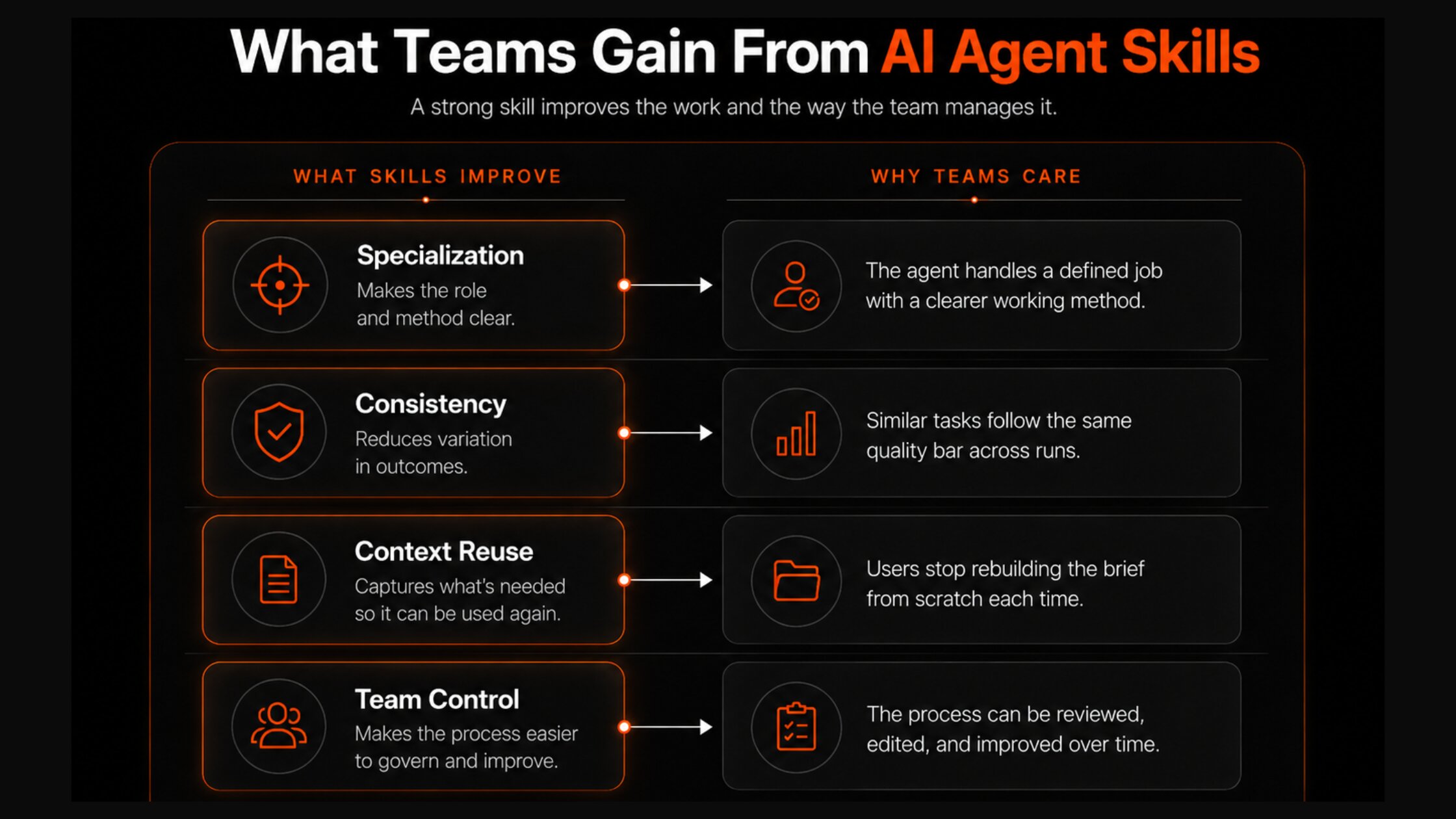
Alt: benefits of using skills in ai agents
Most workflow problems start with a missing standard.
The agent may complete the task, but still use the wrong source, skip a review step, change the format, or continue when approval is needed.
AI agent skills turn that standard into a repeatable method.
They give the agent a clearer route through recurring work, so quality depends less on memory, prompting, or manual cleanup.
A research skill can force source checks before claims appear in a report. A support skill can stop refund promises before a draft reaches the customer. A file-cleanup skill can preserve column rules instead of letting the agent guess what “clean this sheet” means.
How AI Agent Skills Work
AI agent skills give the agent a route through the task before it starts acting.
The work begins with recognition. The agent reads the goal, files, audience, risk level, and expected output to understand the kind of job being requested.
The agent selects the skill that carries the right working method for the task.
Once matched, the skill pulls in the context needed to guide the work: rules, examples, templates, scripts, source preferences, output formats, or review limits.
From there, the agent acts. It may search, read, calculate, update, draft, convert, or prepare a file. The skill keeps each action tied to the task and its boundaries.
The final output should reveal the method behind it. A table, report, draft, file, checklist, or escalation note becomes easier to judge when the path is clear.
The team can then fix the step that failed instead of treating every weak output as a fresh mistake.
It flags: claims with weak sources, major product changes, pricing movement.
Output: short table with source links, confidence notes, and “needs review” items.
Stop point: agent drafts the report but doesn’t publish or message the team without approval.
Core Types of AI Agent Skills
The easiest way to understand AI agent skills is to watch where real work can slip.
A task can go wrong when the agent misinterprets the work, trusts weak context, uses the wrong tool, shapes the output poorly, or keeps going when human judgment should take over.
Each skill type can handle one point in that chain.
Planning and Task Breakdown Skills
Planning skills help with the first decision: what work is actually being asked for.
They let the agent separate the goal from the steps, identify missing inputs, and choose a sensible order. Without planning, the agent can move fast while carrying the wrong assumption throughout the whole task.
Communication and Output Skills
Communication skills protect the final handoff.
They shape the result around the reader, channel, and next action. A support message may need restraint. A sales summary needs signal over volume. A report needs a structure that someone can scan. A team update needs enough context without slowing the reader down.
Research and Retrieval Skills
The agent may need to search websites, read uploaded files, scan internal knowledge, or retrieve past context.
The research and retrieval skills define what deserves trust, what should be ignored, and when the evidence is too thin to use.
Coding and File-Handling Skills
Coding and file-handling skills protect the deliverable.
Some tasks end as a file, script, dataset, sheet, document, or export. This skill helps the agent work on the material itself instead of only explaining what the user should do next.
Tool-Using and Automation Skills
Tool-using skills guide the agent when the task needs a browser, spreadsheet, database, email draft, calendar action, API call, or app connection.
The skill keeps action tied to the task, the permission level, and the right system.
Decision-Making and Escalation Skills
Decision-making skills protect the line between automation and responsibility.
They help the agent handle unclear inputs, conflicting evidence, risky changes, customer impact, money-related actions, and public output. The skill gives the agent a defined way to pause before the wrong work moves forward.
The Agent Stack: Where Skills Turn Ability Into Repeatable Work
An AI agent is much more than a model inside a chat box. It works through layers: reasoning, instructions, skills, tools, integrations, memory, and workflows. The common mistake is treating those layers as interchangeable.
Layer
What it controls
Common mistake
Model
Reasoning, language, and interpretation
Treating it as the full agent system
Instructions
Rules, tone, limits, and quality bar
Treating them as reusable task methods
Skills
Repeatable task knowledge
Confusing them with the tool or app
Tools
Actions outside the chat
Expecting them to define the method
Plugins
Connections to specific apps
Treating one app connection as a workflow
MCP
Standard access to external tools, data, and prompts
Expecting protocol to replace skill logic
Memory
Useful context from past tasks
Assuming recall guarantees accuracy
Workflows
The route from request to outcome
Reducing the full process to one skill
Skills are the middle layer between what the model can understand and what the agent should be allowed to do.
How Moclaw.ai Makes Skill-Based Workflows Practical
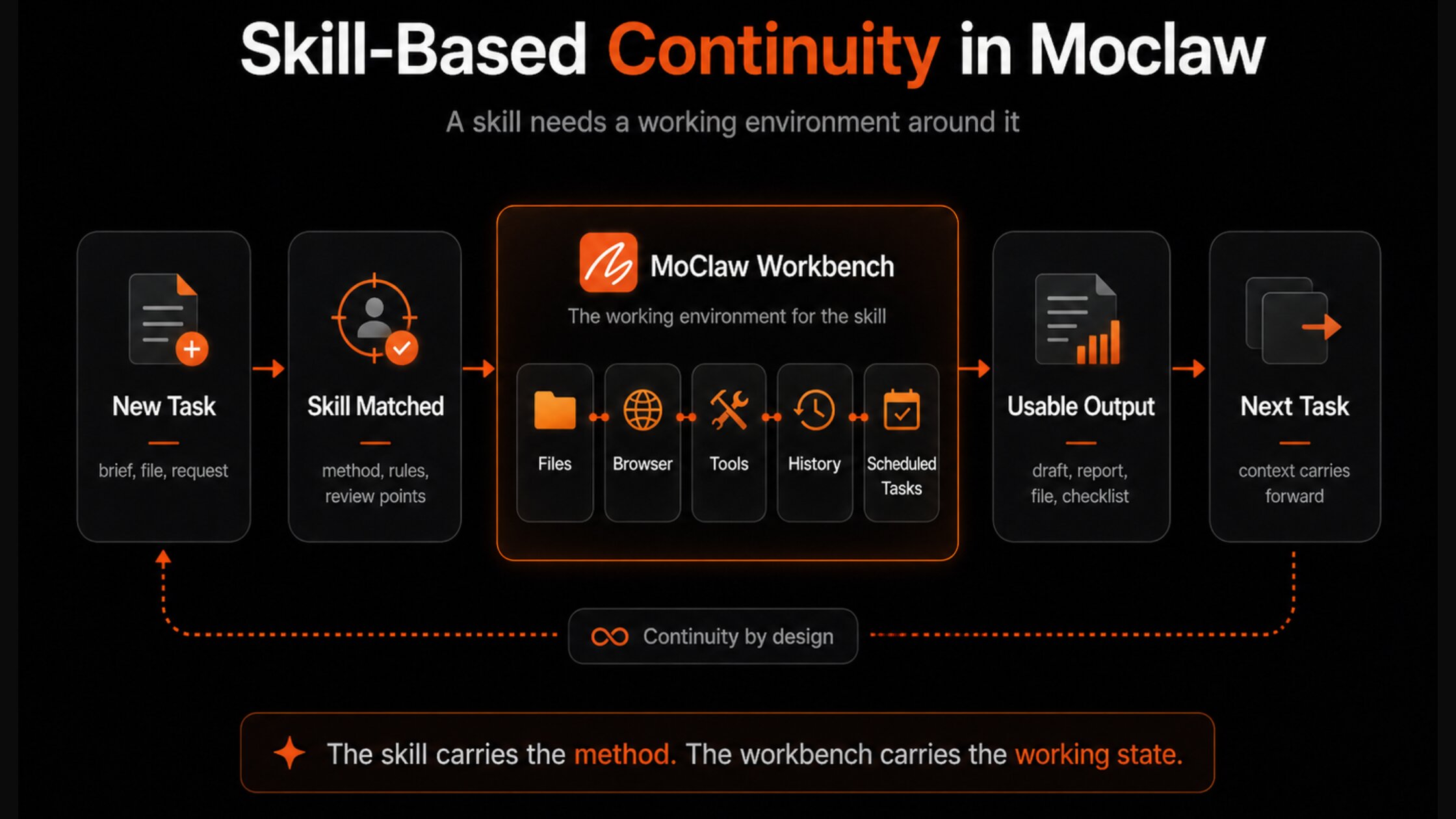
Alt: ai agent skills in practice
A skill becomes more useful when the agent has a workbench around it.
Real tasks don’t stay inside one response. They move through pages, files, drafts, sheets, source checks, review notes, and follow-up steps. The method may be ready, but the agent still needs access to the pieces that make the process useful.
Moclaw.ai gives the agent a cloud computer environment for that workbench. Files, browser activity, chat history, skills, scheduled tasks, and connected tools can remain part of the same working space.
The practical gain is continuity. The agent spends less time recovering context and more time moving the task forward.
Inside Moclaw’s Deep-Research Skill
Alt: built in agentic skills in moclaw
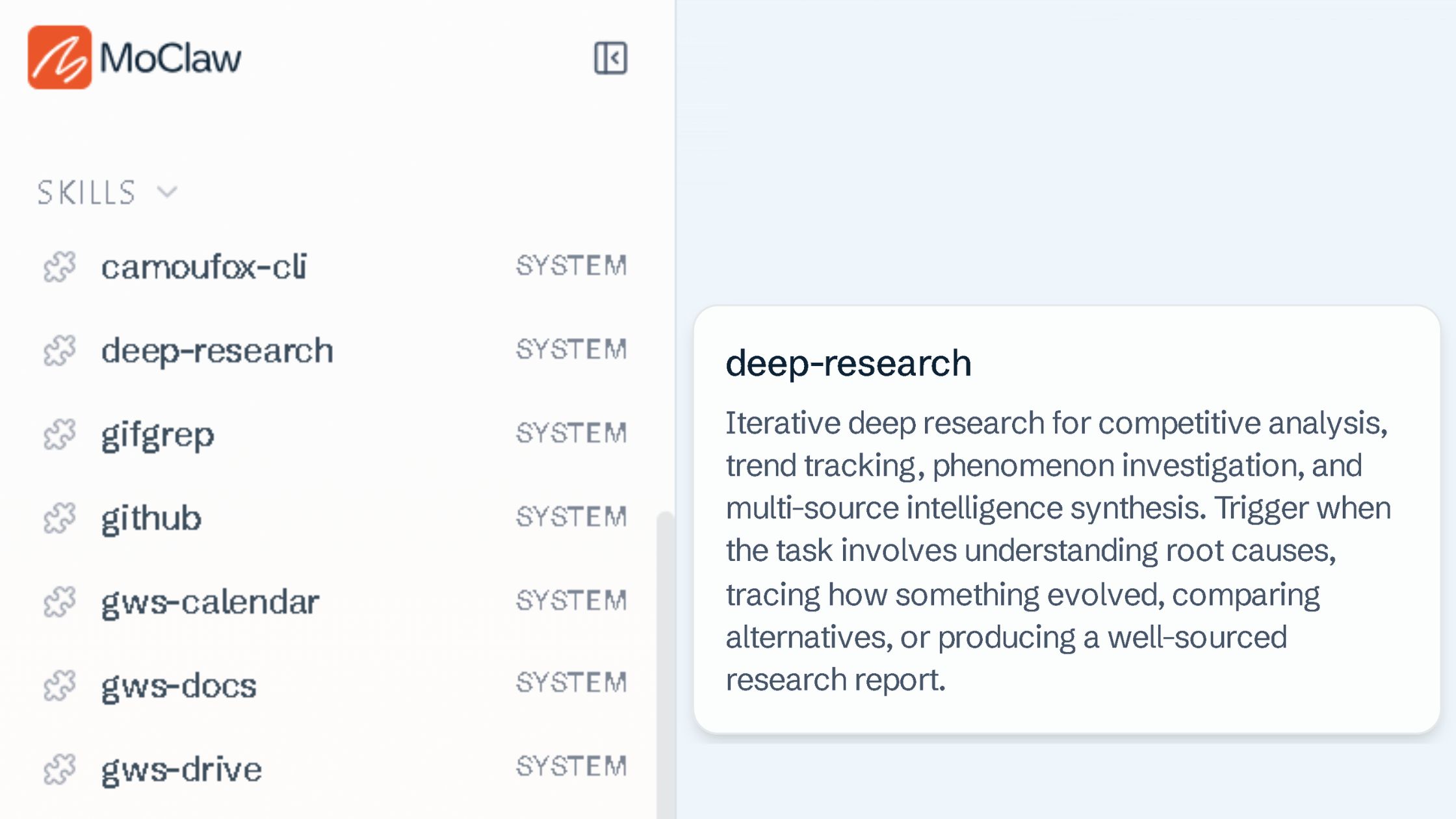
Moclaw offers a growing library of built-in skills, and its deep-research skill serves as a quality-control system for research work.
The skill starts with the question behind the question.
What needs to be understood? Who is the research for? What format should the final output take? Which sub-questions are still open?
From there, the agent tracks gaps instead of chasing sources.
Each research pass has a target. The agent chooses a small set of gaps, picks the right strategy, reads or searches, records what changed, and updates the gap list. New gaps can appear. Weak claims can be reopened. Bad sources can force the agent to backtrack.
The skill prevents the agent from turning partial understanding into a confident report.
It also makes the work easier to inspect. Notes, findings, sources, and gaps are separated. Source reliability is marked. Uncertainty is not hidden. Writing begins only when the research has enough depth to support the answer.
This is what a strong AI agent skill adds: not just action, but restraint.
It tells the agent how to move forward, how to check itself, and when the work is not ready yet.
Where Skills in AI Agents Break Down
A weak skill rarely announces itself. The agent may return a polished answer, but polish doesn’t prove the work was handled well. The real risk is how confident the result can look while the work underneath is already off.
Wrong Skill, Wrong Path
Many failures begin with routing.
The request sounds clear to the user, yet the agent matches the wrong method inside the system.
It may follow that method neatly and still return an answer built on the first bad assumption.
Weak Instructions, Weak Standards
A weak skill gives the task a name without defining the standard.
It may skip source rules, edge cases, approval points, quality checks, or output format.
The model then fills the gaps with judgment the team never approved.
Bad Context, Bad Output
A good method can’t rescue bad inputs.
Old files, partial briefs, conflicting sources, and stale memory can quietly bend the task before the work begins.
The agent may follow the skill correctly while solving the wrong version of the problem.
Broad Access, Bigger Mistakes
Risk rises when the agent can change real systems.
A loose method with broad permissions can edit records, overwrite files, publish drafts, or message customers before review.
Access should expand only after the process earns trust.
No Clear Stop Point
Some workflows fail because the agent keeps going when it should pause.
A skill needs a defined stop point, especially near money, customer data, legal risk, publishing, or system changes.
Without that boundary, speed becomes a liability.
No Ownership, No Reliability
Skill libraries decay when nobody owns them.
Versions drift. Duplicate methods compete. Review points disappear. Teams stop knowing which skill reflects the current way of doing the work.
The safest skills usually share three traits:
Clear ownership
Narrow boundaries
A defined stopping point
Final Thoughts
Every team runs on a working standard that rarely lives in one place.
Some of it lives in documents. Most of it revolves around judgment: what counts as enough context, which source needs verification, when a customer reply feels too risky, and when a report is ready.
Those decisions often disappear between tasks. People change. Files move. Tools reset. The next run starts with less knowledge than the last one earned.
AI agent skills help close that leak.
They give the agent enough of the working standard to carry it into the next run, so repeated work doesn’t keep falling back to whoever remembers the process best.
The question becomes harder to ignore:
What part of your process still disappears before the next task begins?